
This page contains free training Articles
Check FREE Online Workshop below
Latest Articles
Why Video Editors Struggle with Footage
Lighting
- What Lighting Is: Foundations
- From Colour Temperature to CRI, TLCI, and Spectral Metrics
- Measuring Light for Cameras
- Three-Point Lighting as a Control System
- Rembrandt Lighting
- Motivated, Practical, and Naturalistic Lighting
- LED Lighting as an Engineered Light Source
- Designing Lighting for Multi-Camera and Hybrid Environments
Sound
- What Sound Is: Physics, Waves, and Perception
- Frequency, Harmonics, and Timbre
- Loudness, Level, and the Decibel System
- Microphones as Transducers (Engineered Devices)
- Acoustics and the Recording Environment
- Signal Flow and Gain Structure
- Measuring Sound: Meters, dBFS, VU, and LUFS
- Failure Modes in Sound: Distortion, Clipping, Phase, Noise, and Comb Filtering
____________________________________________________
Camera Foundations
Applied Studio Techniques
____________________________________________________
Photography
Photography and Its Role in Television and Film
____________________________________________________
Video Over IP in Studio Production
- Why Video over IP Is Rapidly Replacing Traditional Baseband Systems
- What “Video over IP” Means in a Broadcast Context
- Video over IP in Studio Production
- Remote Contribution and Distributed Production
- Post-Production Workflows and IP Thinking
- SDI Distribution Versus IP Distribution
- SMPTE ST 2110: The Core Broadcast IP Standard
- Blackmagic Design and Video over IP
- Broadcasters Using Video over IP
- A Practical Perspective
____________________________________________________
Studio Acoustics in Television and Film Production
____________________________________________________
Reverberation Time (RT60) and Enclosure Behaviour: How Rooms Shape Sound
____________________________________________________
Camera Movement, Motivation and Mounts in the Television Studio
Camera Movement, Motivation and Mounts in Film Production
_________________________________________________________________________________
Mini Case Studies: Television Studio
Mini Case Studies: Film Production
FREE WORKSHOP Register with form below
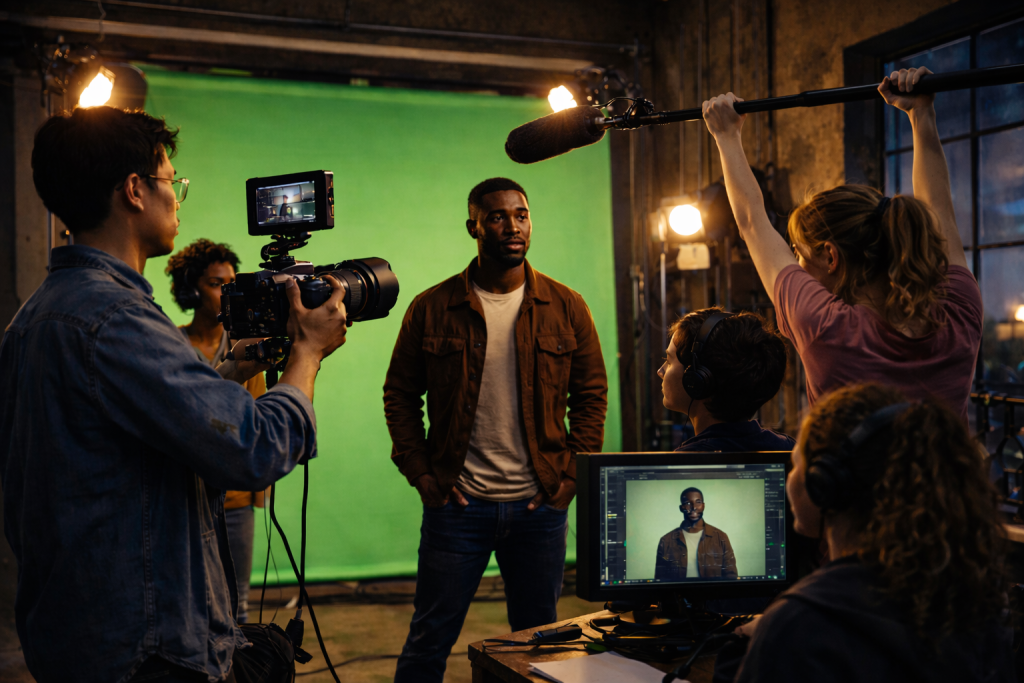
If you’re making your first film, the quickest way to improve your work is to master three essentials: framing, composition, and camera movement. These are the practical “mechanics” of visual storytelling with the tools that guide the viewer’s attention and shape how a moment feels.
1) Framing: What the audience sees (and what you keep out)
Framing is the world inside the edges of the shot. It decides what matters in the moment.
- Shot sizes: when to use a wide shot for context, and a close-up for emotion and detail.
- Angles: how a low angle can suggest power, and a high angle can suggest vulnerability.
2) Composition: Arranging the frame so it reads clearly
Composition is how elements sit inside the frame to create balance, meaning, and visual flow.
- Rule of thirds: a strong starting point that helps shots feel natural and engaging.
- Leading lines: using roads, walls, or objects to pull the eye toward your subject.
- Headroom & lead room: simple choices that make shots look professional and intentional.
3) Movement: Adding energy with purpose
Movement should be motivated by story or information, not used “just because you can.”
- Pans & tilts: controlled moves on a fixed axis to reveal information or follow action.
- Dolly & tracking: moving the camera to build tension, follow action, or shift perspective.
- Handheld: a deliberate choice that can add realism, urgency, or unease.
Why start here?
Because these three pillars form the blueprint of your film. A great script can still fall flat if framing is messy, composition is confusing, or camera movement distracts the viewer. Many beginners also learn using the Five C’s of Cinematography (Camera Angles, Continuity, Cutting, Close-ups, and Composition), you’ll see how framing, composition, and movement sit at the centre of that foundation.
Where to from here? Join the free online workshop (March 2026).
I’m hosting a free, two-hour online session that introduces the fundamentals and a practical approach to making your own short film. Registration is required: please use the link below only. After you register, you’ll receive the confirmed dates and times, plus the joining details.
REGISTER BELOW FOR THE FREE WORKSHOP